A paper bag may look premium when it first comes out of production, but the real test begins when customers start carrying products inside it. If the bottom bends, the handles pull loose, or the bag loses its shape, the packaging can quickly affect how customers perceive the brand.
For retail brands, paper bag strength is not only about using thicker paper. It depends on the right material, reinforced bottom, handle support, bag structure, glue quality, and proper testing before production. As a paper packaging manufacturer in Vietnam, VPN Packaging Factory produces custom paper bags, paper boxes, gift boxes, and retail packaging for brands that need both strong structure and professional presentation. This guide explains how to make paper bags stronger in a practical way, especially for cosmetics, fashion, gift, food, and premium retail packaging.
Why Paper Bags Fail Even When They Look Good
Many weak paper bags do not fail because they look cheap. They fail because the structure does not match the real weight and usage of the product. This is why a bag can look beautiful in product photos but perform poorly in real customer use.
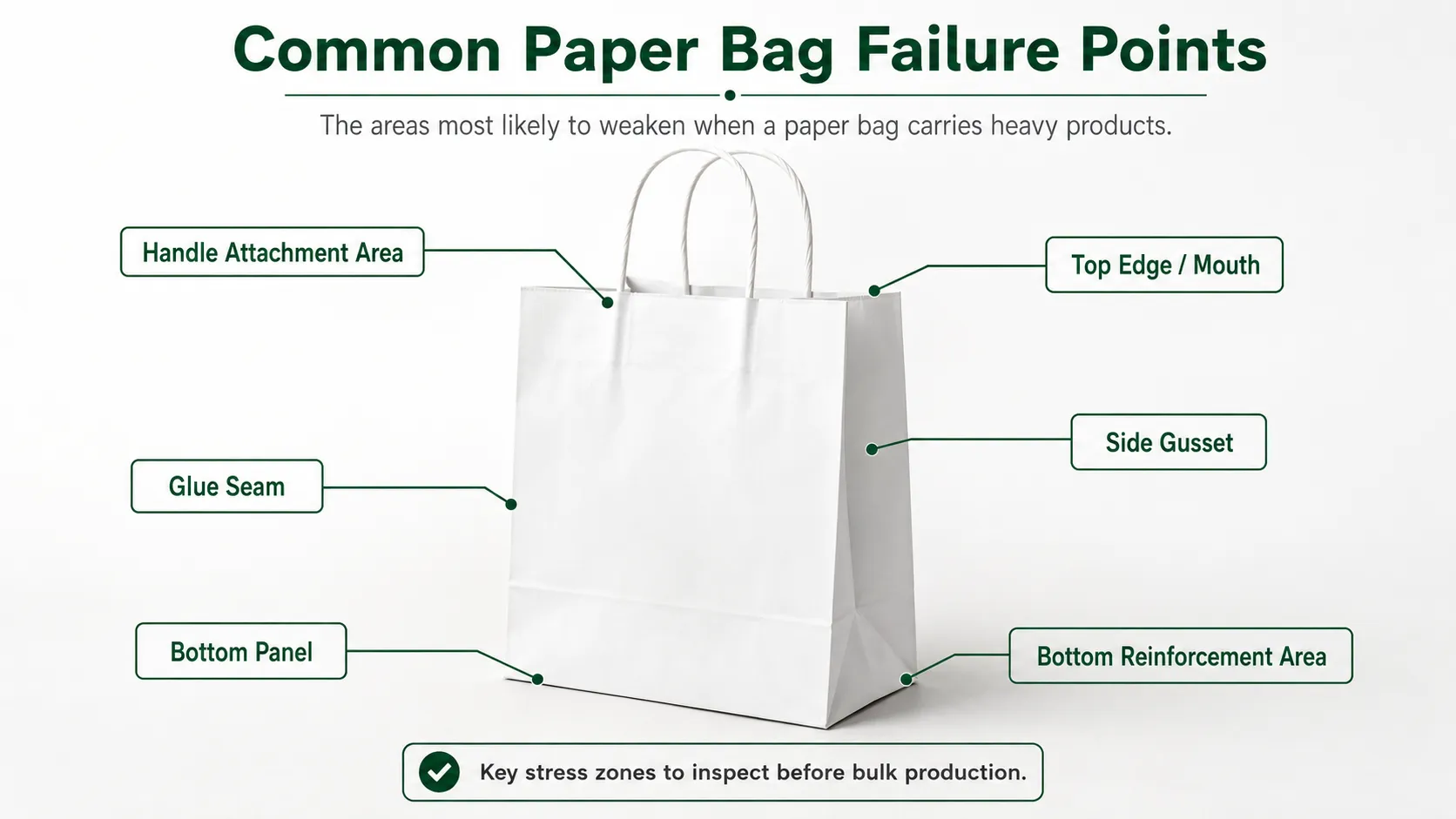
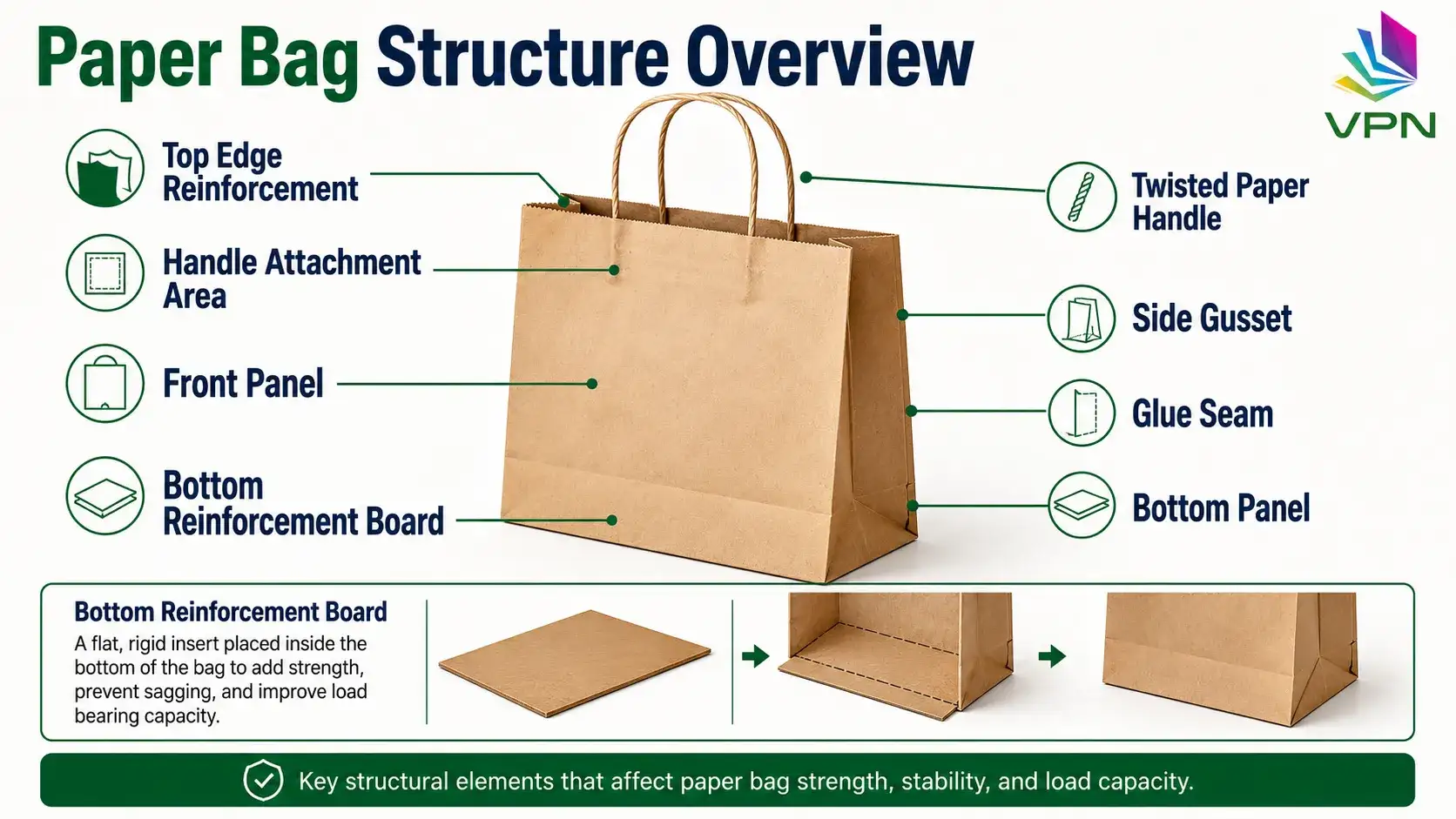
Most paper bag failures happen around a few key areas: the bottom panel, the handle attachment area, the side gussets, the glue seams, and the top opening. These areas carry most of the stress when the bag is loaded and lifted. If any of them are too weak, the bag may slowly lose shape or tear during use.
| Common Failure Area | What Usually Happens | Main Cause |
|---|---|---|
| Bottom panel | The base bends, sags, or tears | Product weight is not properly distributed |
| Handle area | Paper tears around the handle holes | Weak top reinforcement or poor handle attachment |
| Side gussets | Bag loses shape or folds unevenly | Poor structure or unsuitable bag size |
| Glue seams | Edges separate during use | Weak adhesive or poor production precision |
| Top opening | Bag mouth becomes loose or ripped | Thin paper or no folded reinforcement |
This is why judging a paper bag only by its design is risky. A strong paper bag should look good, but it also needs to behave well when carried. It should stand properly, hold the product weight, keep its shape, and feel comfortable in the customer’s hand.
For B2B buyers, this is an important point. If you are ordering custom paper bags for your brand, the question should not only be, “What does the bag look like?” A better question is, “Can this bag carry our product safely and still feel premium after real use?” That is the difference between decorative packaging and functional retail packaging.
Paper Material Matters More Than Many Brands Think
The first step in making paper bags stronger is choosing the right paper material. Many people immediately look at GSM when discussing paper bag strength. GSM, or grams per square meter, measures the weight of the paper. In general, higher GSM paper feels thicker and more rigid, but GSM is not the whole story.
Two papers with the same GSM can perform very differently depending on the quality of the fiber, paper density, coating, flexibility, and tear resistance. This is why a 200 GSM kraft paper bag may sometimes feel stronger in real use than another 200 GSM coated paper bag.
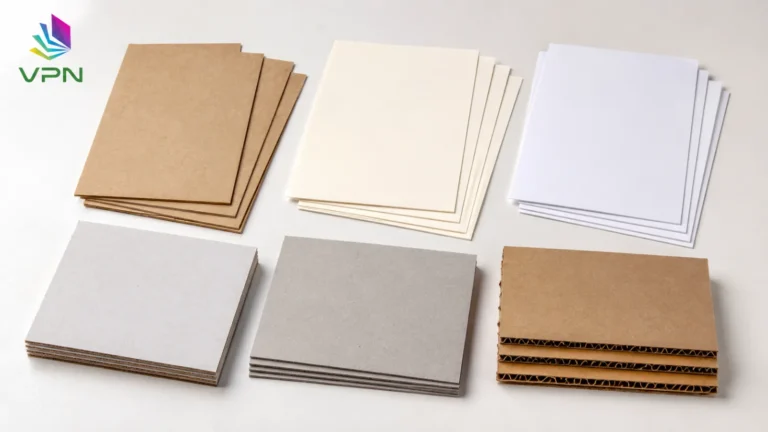
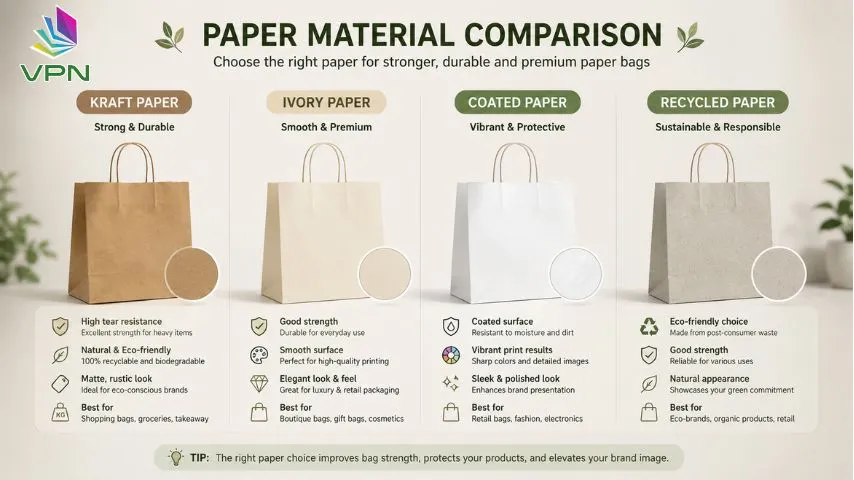
Kraft paper is often chosen for durable paper bags because its fibers are generally longer and stronger. It can handle stress better and is less likely to crack around folds. This makes kraft paper suitable for takeaway bags, shopping bags, eco-friendly packaging, and heavy-duty retail use.
Ivory paper and coated paper are often chosen for luxury paper bags because they provide a smoother surface and better printing results. These papers are excellent for premium branding, but they may need additional reinforcement if the bag is used for heavier products.
Recycled paper is also becoming more popular because of sustainability goals. However, recycled fiber quality can vary. If the recycled paper is not strong enough, the bag may need better structural support to compensate.
| Paper Material | Strength Level | Visual Appearance | Best For |
|---|---|---|---|
| Kraft paper | High | Natural, eco-friendly | Food, retail, shopping, heavier items |
| White kraft paper | Medium to high | Clean and natural | Retail, fashion, eco brands |
| Ivory paper | Medium | Smooth and premium | Gift bags, cosmetics, luxury retail |
| Coated/art paper | Medium | High-end printing | Premium branding, events, luxury bags |
| Recycled paper | Varies | Sustainable look | Eco-conscious brands |
The best material depends on the product. A fashion brand may prioritize elegance and printing quality. A food business may prioritize grease resistance and practicality. A cosmetic brand may need a balance between luxury appearance and strong structure. This is why experienced manufacturers do not choose paper based on GSM alone. They look at the actual product, expected carrying weight, brand positioning, and customer experience.
Choosing the Right GSM for Paper Bag Strength
GSM is still important, even though it is not the only factor. If the paper is too thin, the bag may feel weak, especially when carrying boxed products or items with sharp corners. If the paper is too thick, the bag may become bulky, harder to fold, and more expensive than necessary.
The goal is not always to choose the highest GSM. The goal is to choose the right GSM for the product. A lightweight retail item does not need the same structure as a candle set, perfume box, or cosmetic gift package.
| Product Type | Suggested Paper Range | Notes |
|---|---|---|
| Lightweight retail items | 120–170 GSM | Suitable for small accessories, lightweight products |
| Food takeaway bags | 120–180 GSM | Kraft paper is commonly used |
| Fashion paper bags | 170–230 GSM | Needs balance between strength and appearance |
| Cosmetic paper bags | 190–250 GSM | Often requires reinforced top and bottom |
| Gift paper bags | 210–250 GSM | Better structure for premium presentation |
| Perfume or candle packaging | 230–300 GSM | Bottom board and handle reinforcement recommended |
| Heavy-duty paper bags | 250 GSM+ | Should be tested based on actual product weight |
This table should not be used as a fixed rule. It is a starting point. For example, a small perfume box may be compact but heavy for its size. A large fashion item may be physically bigger but not very heavy. These two products need different bag structures.
That is why product weight, size, and shape should always be considered together. A well-designed paper bag does not just use strong paper. It uses the right paper for the right product.
Bottom Reinforcement Is Critical for Heavy Products
If a paper bag feels weak, the problem often starts at the bottom. The bottom panel carries most of the product weight. When a customer places products inside the bag, the load pushes downward immediately. If the bottom is not reinforced, the pressure concentrates around the folds and glued areas.
At first, the bag may only look slightly curved. But after a short time, the base may begin to sag. The product may shift inside. The bag may lose its standing shape. In worse cases, the bottom seam can open or tear.
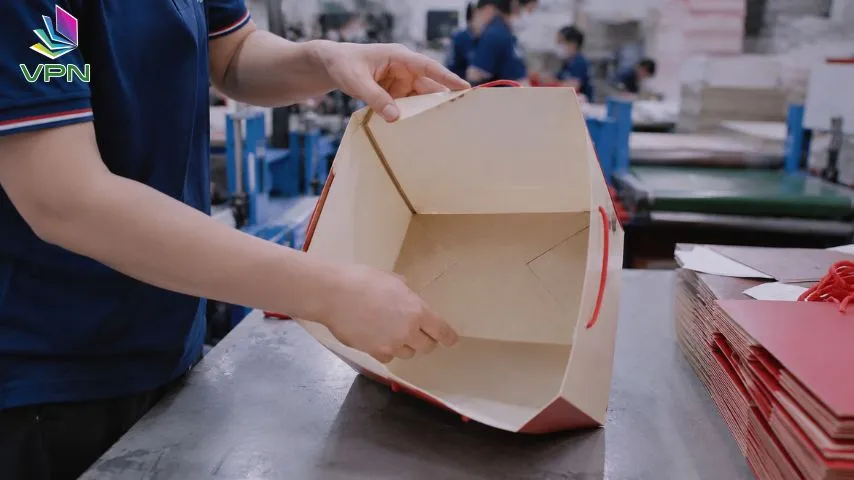
This is why bottom reinforcement is one of the most important ways to make paper bags stronger. A bottom board or cardboard insert helps spread the weight across the base. Instead of forcing the paper folds to carry all the pressure, the bottom board creates a more stable platform.
Customers may not directly notice the bottom board, but they notice the feeling it creates. The bag feels firmer, stands better, and carries weight more confidently. This is especially important for compact but heavy products such as perfume boxes, candles, cosmetic sets, gift boxes, glass bottles, and small electronics.
| Product Category | Why Bottom Reinforcement Matters |
|---|---|
| Perfume boxes | Compact but often heavy |
| Cosmetic sets | Multiple small products create concentrated weight |
| Candles | Dense and heavy for their size |
| Gift boxes | Presentation depends on stable bag shape |
| Glass bottles | Require better weight distribution |
| Electronics | Need stable support and clean structure |
A reinforced bottom also improves the premium feeling of the bag. Luxury packaging often feels expensive not because every part is visibly thick, but because the structure stays controlled when handled. That controlled feeling is what customers remember.
The Handle Area Needs More Than a Strong Handle
Many people think paper bag handles fail because the handle material is weak. Sometimes that is true, but very often, the real problem is not the handle itself. The problem is the area where the handle connects to the paper.
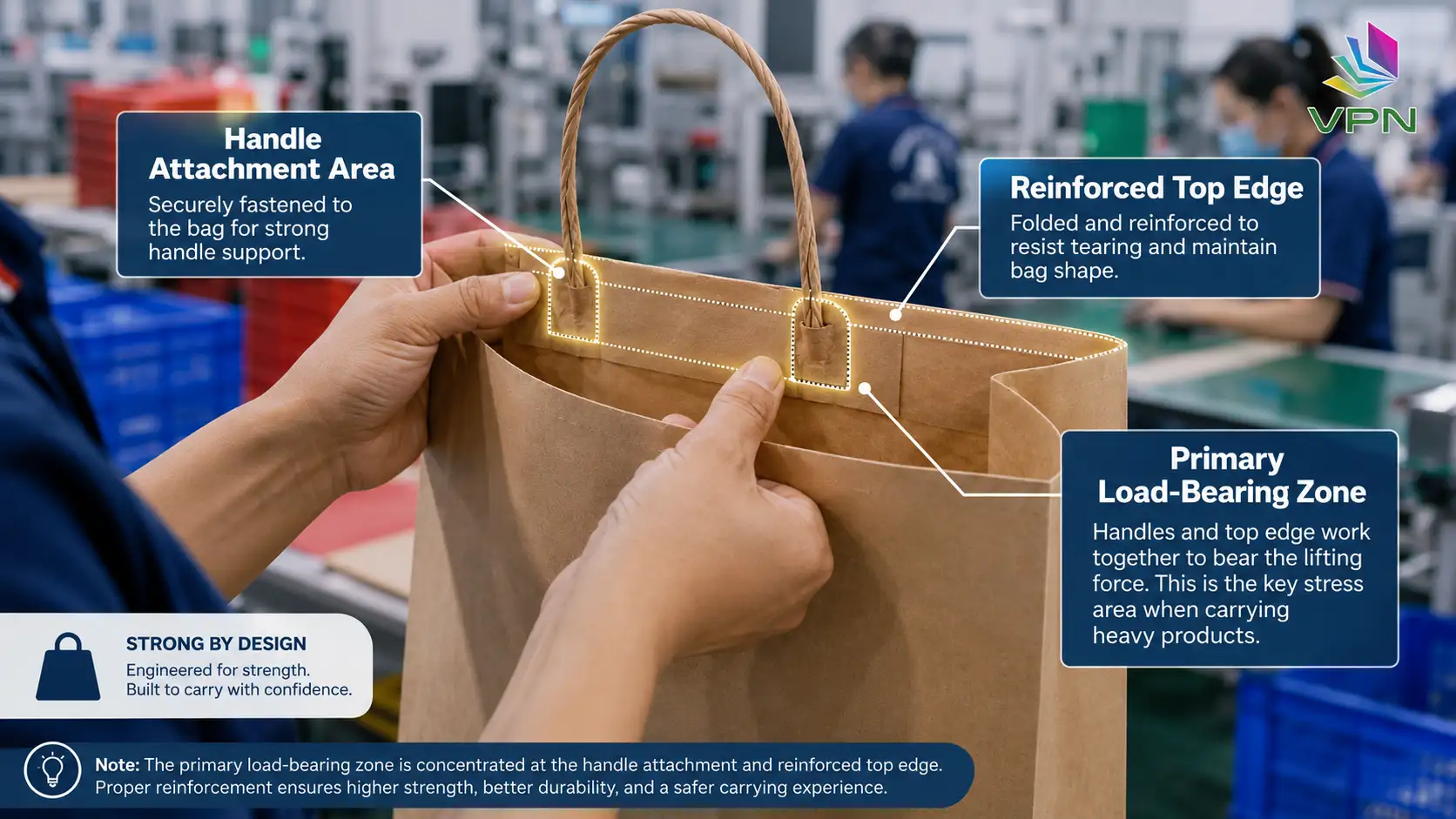
When someone lifts a paper bag, the upward force is concentrated around the handle attachment points. If this area is thin, poorly folded, or not reinforced, the paper slowly weakens around the holes or glued sections. That is why a strong paper bag needs both a strong handle and a strong handle area.
| Handle Type | Strength | Appearance | Best For |
|---|---|---|---|
| Twisted paper handle | Medium | Simple, eco-friendly | Food, retail, takeaway |
| Flat paper handle | Medium | Clean and practical | Shopping bags, grocery bags |
| Cotton rope handle | High | Premium and comfortable | Cosmetics, fashion, gift bags |
| Ribbon handle | Low to medium | Elegant and decorative | Boutique, events, lightweight gifts |
| Die-cut handle | Varies | Minimal and modern | Small bags, light products |
Cotton rope handles are often preferred for premium paper bags because they feel comfortable and strong. However, even a cotton rope handle can fail if the paper around it is not supported properly.
To improve handle strength, manufacturers may use folded top edges, inner reinforcement patches, thicker paper around handle holes, stronger knots, and better spacing between handle points. The spacing matters too. If the handle holes are too close together, the lifting force becomes more concentrated. If they are placed too close to the top edge, the paper can tear more easily.
This is why handle design is not only a visual decision. It is a structural decision. For brands, this detail is important because the handle is the part customers physically touch the most. If the handle feels uncomfortable, unstable, or risky, the whole packaging experience feels weaker.
Bag Size and Proportion Can Make a Strong Bag Feel Weak
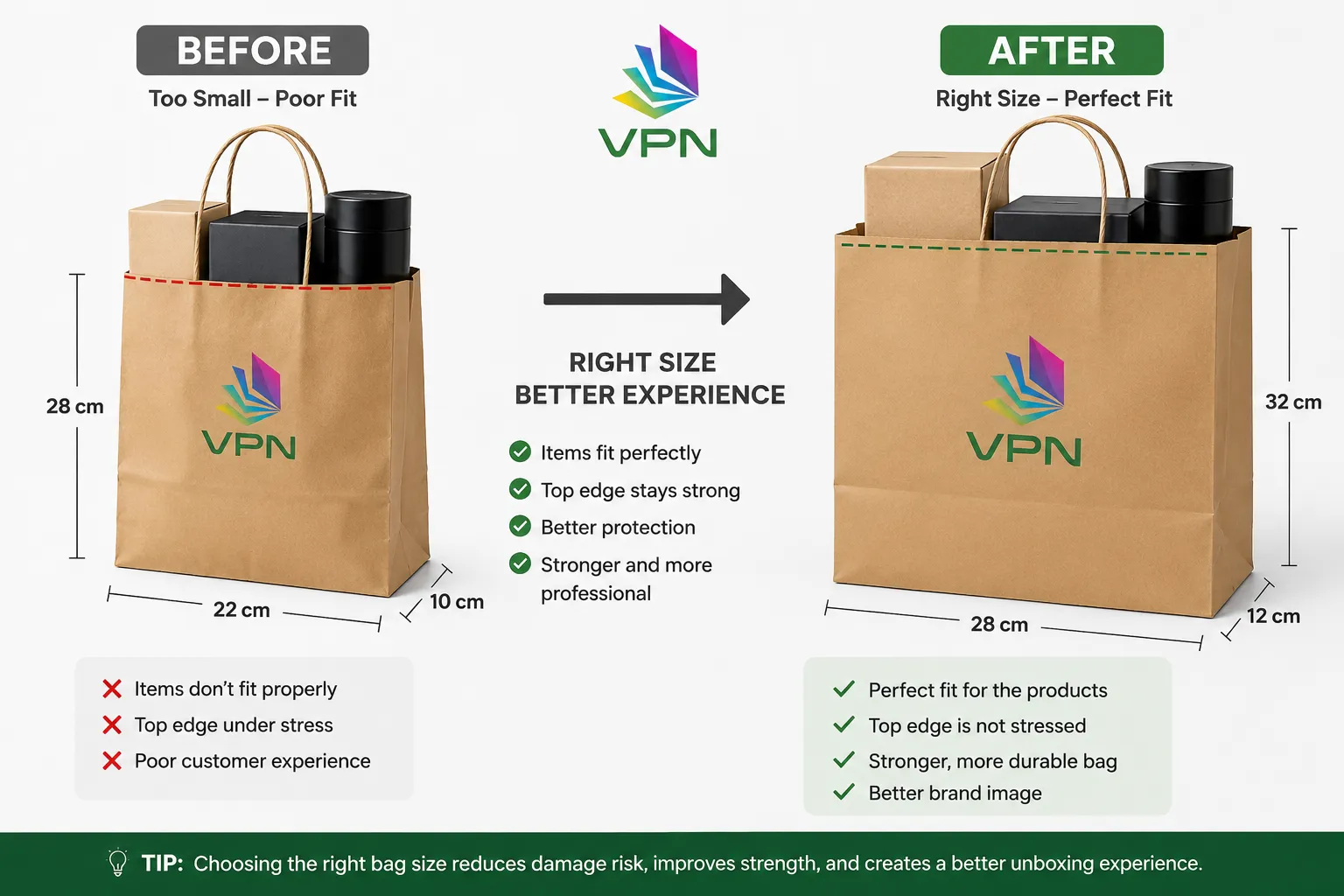
A paper bag can use good material and still feel weak if the size is wrong. This happens often when brands choose oversized bags because they want the packaging to look more impressive. The problem is that a large bag carrying a small but heavy product can become unstable.
The product moves inside the bag. The weight shifts when the customer walks. The handles pull unevenly. The side walls bend more than necessary. In this situation, even thick paper may not solve the problem.
A better approach is to design the bag around the actual product size and weight.
| Product Situation | Better Bag Design Approach |
|---|---|
| Small but heavy product | Use compact bag size with reinforced bottom |
| Tall bottle or box | Use taller bag with stable side gusset |
| Multiple small products | Use wider base and stronger bottom board |
| Lightweight fashion item | Use larger bag but moderate GSM |
| Luxury gift set | Use premium paper with balanced structure |
The goal is to reduce unnecessary movement inside the bag. When the product sits properly inside the packaging, the bag feels more balanced. The customer does not feel the weight shifting around. The handles stay more stable. The side panels maintain their shape better.
This is one reason custom paper bags often perform better than generic stock bags. A custom bag can be designed around the product instead of forcing the product into a standard size. For B2B buyers, this can make a big difference in customer experience.
Side Gussets and Fold Structure Affect Load Distribution
The side gusset is the folded side section that allows a paper bag to expand. Many people see it only as a size feature, but it also affects strength.
A good gusset helps the bag open properly, hold volume, and distribute pressure more evenly. A poor gusset can cause the bag to fold awkwardly, lean to one side, or lose shape when products are placed inside.
Fold accuracy also matters. If the folds are not aligned properly, one side of the bag may carry more stress than the other. Over time, this can create weak points. This is especially important for square bottom paper bags and luxury shopping bags where shape retention is part of the brand presentation.
| Structure Detail | How It Helps |
|---|---|
| Side gusset | Gives the bag more space and stability |
| Square bottom | Helps the bag stand upright |
| Folded top edge | Strengthens the mouth and handle area |
| Bottom board | Spreads weight across the base |
| Accurate glue seam | Keeps the structure stable under pressure |
A strong paper bag is not only a piece of paper folded into shape. It is a structure designed to manage pressure. That is why the same paper can produce two very different bags depending on how it is folded, glued, and reinforced.
Glue Quality and Manufacturing Precision Should Not Be Ignored
Glue is not the most exciting part of paper bag production, but it is one of the most important. A paper bag may look perfect when newly produced, but weak glue can create problems later during transportation, storage, or real customer use.
Poor glue quality may lead to side seams opening, bottom edges separating, folded areas becoming loose, and reduced load-bearing ability. Humidity can make the problem worse. Paper naturally reacts to moisture, and weak adhesive systems may lose performance in humid conditions.
For export packaging or international shipping, this matters even more. Bags may go through different temperatures, storage environments, and handling conditions before reaching the final customer.
Manufacturing precision also affects durability. If glue is applied unevenly, if the folds are not pressed properly, or if the reinforcement is not aligned correctly, the bag may have hidden weak points. These weak points may not be visible at first, but they appear when the bag is loaded.
This is why professional paper bag production requires consistency, not just good materials. In bulk orders, quality control becomes essential because one perfect sample does not guarantee that every bag in mass production will perform the same way.
Recommended Paper Bag Specifications by Use Case
For brands, the easiest way to choose a stronger paper bag is to match the bag specification to the actual product use. A food takeaway bag, a luxury cosmetic bag, and a heavy-duty shopping bag should not use the same structure.
| Use Case | Recommended Material | Suggested Structure | Handle Option |
|---|---|---|---|
| Food takeaway | Kraft paper | Square bottom, moderate gusset | Twisted paper handle |
| Fashion retail | White kraft or art paper | Reinforced top edge | Cotton rope or paper handle |
| Cosmetic products | Ivory/art paper | Bottom board + top reinforcement | Cotton rope handle |
| Gift packaging | Ivory/art paper | Strong bottom board, premium finishing | Ribbon or cotton rope |
| Perfume/candle bags | Thick paper or reinforced coated paper | Rigid bottom board + handle patching | Cotton rope handle |
| Eco retail brands | Kraft/recycled paper | Reinforced bottom if needed | Paper handle |
| Heavy-duty shopping bags | High GSM kraft or laminated paper | Reinforced base, side gusset, top support | Rope handle |
This type of table is useful because it answers what buyers actually want to know. They are not only asking, “How do I make paper bags stronger?” They are also asking, “What kind of paper bag should I choose for my product?”
That is why matching the structure to the product category is more helpful than giving a generic answer.
How to Test Paper Bag Strength Before Bulk Production
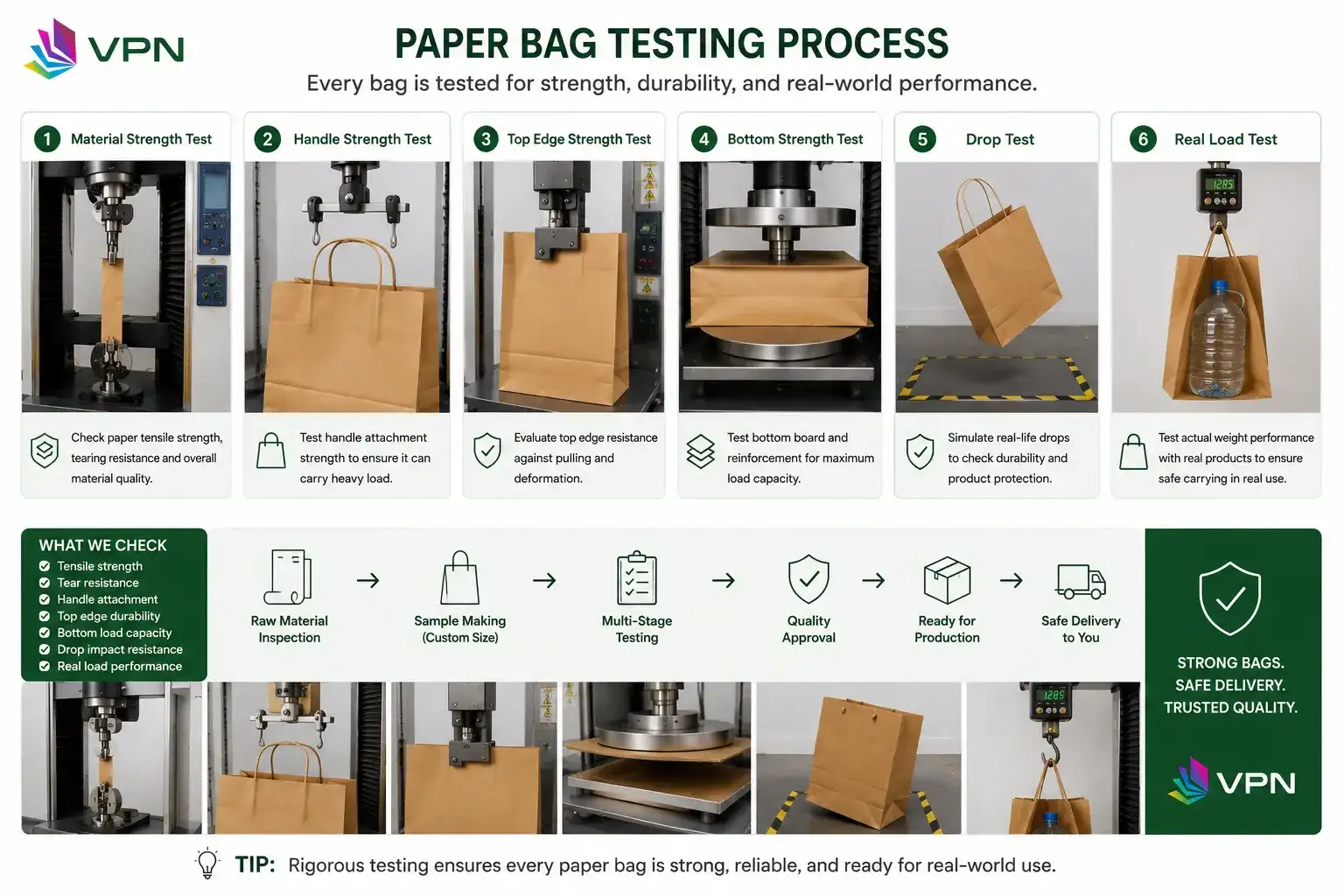
A paper bag should be tested before large-scale production, especially if it will carry medium or heavy products. Testing does not have to be complicated in the early stage. Even practical sample testing can prevent many packaging problems.
Before approving a bulk order, brands should check whether the bag can carry the expected product weight, whether the handle area tears or deforms, whether the bottom sags under pressure, and whether the bag remains comfortable when carried.
| Test Item | What to Check |
|---|---|
| Load test | Can the bag carry the expected product weight safely? |
| Handle test | Does the handle area tear, stretch, or deform? |
| Bottom test | Does the base sag or open under weight? |
| Standing test | Can the bag stand upright after products are placed inside? |
| Walking test | Does the bag remain comfortable and stable when carried? |
| Humidity observation | Does the paper or glue weaken in humid conditions? |
| Visual inspection | Are folds, seams, and reinforcement aligned properly? |
A simple but useful method is to place the actual product inside the sample bag and carry it for several minutes. This gives a much better sense of real performance than only checking the empty bag.
For heavier products, it is also helpful to test slightly above the expected product weight. This gives a safety margin. For example, if the product weighs 2 kg, the bag should ideally be tested above that weight to make sure it can handle real-life movement, not just static loading.
Real use is never perfectly controlled. Customers walk, swing the bag slightly, place it down, pick it up again, and sometimes add other items inside. A strong paper bag should handle these normal behaviors without losing shape too quickly.
Common Mistakes That Make Paper Bags Weaker
Many paper bag problems come from small decisions made early in the design stage. The most common mistake is choosing paper only based on appearance. A beautiful coated paper may be perfect for printing, but if the bag needs to carry heavy products, it may require stronger structure underneath.
Another mistake is using the same bag specification for every product. A small jewelry item, a candle, and a cosmetic gift set do not need the same bag design. Each product has different weight, shape, and carrying behavior.
Some brands also choose decorative handles without considering real load. Ribbon handles may look elegant, but they may not be the best choice for heavier products. The fourth mistake is ignoring the bottom. Many people focus on the paper surface and handle style, while the bottom is the part carrying most of the weight.
Finally, some brands approve samples too quickly. The bag may look good in a photo, but it should be tested with the real product before bulk production.
| Mistake | Result | Better Solution |
|---|---|---|
| Choosing paper only for appearance | Bag looks good but feels weak | Balance print quality with structure |
| Using thin paper for heavy products | Bottom bends or tears | Increase GSM or add reinforcement |
| Ignoring handle attachment | Handle area rips | Reinforce top edge and handle holes |
| Oversized bag for compact products | Weight shifts inside | Match bag size to product |
| Weak bottom structure | Bag loses shape | Add bottom board |
| Poor sample testing | Problems appear after production | Test with real product weight |
These mistakes are avoidable if the brand and manufacturer discuss function before finalizing the design.
Strong Paper Bags Also Improve Brand Perception
Durability is not only a technical issue. It is also a branding issue. Customers naturally connect packaging quality with product quality. When a bag feels firm, balanced, and comfortable, the product inside feels more valuable.
This is why luxury brands care so much about packaging structure. The bag is not just a container. It is part of the brand experience.
A strong paper bag can create several benefits for a brand. It improves the first impression, increases perceived product value, makes the customer experience more comfortable, supports reuse, and gives the brand more visibility after purchase.
Reusable paper bags are especially valuable because customers may keep them for later use. Every time they reuse the bag, the brand gets more exposure. Weak bags disappear quickly. Strong bags stay longer.
This is also connected to sustainability. A durable paper bag is more likely to be reused, which supports eco-conscious branding better than a bag that is thrown away immediately.
For brands that want to replace plastic bags, strength becomes even more important. Customers may like sustainable packaging, but they still expect it to perform well. A paper bag should not only be recyclable. It should be reliable.\
FAQ About Making Paper Bags Stronger
What makes a paper bag stronger?
A stronger paper bag usually comes from the right combination of paper material, GSM, reinforced bottom, strong handle attachment, good glue quality, and proper bag size. Using thicker paper helps, but structure is just as important.
Is higher GSM always better for paper bags?
Not always. Higher GSM usually makes paper thicker and more rigid, but it can also make the bag less flexible and more expensive. The best choice depends on product weight, paper type, bag size, and how the bag will be used.
What is the best paper for strong paper bags?
Kraft paper is often one of the strongest options because of its fiber structure. However, ivory paper and coated paper can also be used for strong luxury paper bags when combined with proper reinforcement.
How do you stop paper bag handles from tearing?
The handle area should be reinforced with folded top edges, internal support patches, stronger paper around handle holes, and suitable handle spacing. The handle material matters, but the attachment area is usually more important.
Why does the bottom of a paper bag sag?
The bottom usually sags when the product weight is not distributed properly. Adding a cardboard bottom board or using a better square-bottom structure can help the bag stay firm and stable.
Are paper bags strong enough for heavy products?
Yes, paper bags can carry heavier products if they are designed correctly. Heavy-duty paper bags usually need stronger paper, reinforced bottoms, supported handle areas, good glue, and proper testing before production.
Should luxury paper bags use kraft paper or coated paper?
It depends on the brand style. Kraft paper is strong and natural-looking, while coated paper offers better print quality and a more premium surface. For luxury products, coated paper with hidden reinforcement is often a good choice.
Final Thoughts
Making paper bags stronger is not about one single material upgrade. It is about designing the bag as a complete structure. The paper must be suitable for the product. The bottom must support the weight. The handle area must handle repeated lifting. The size must match the product. The glue and folds must stay stable during real use.
A strong paper bag does not need to look bulky. In fact, the best bags often feel strong in a quiet way. They stand properly, carry comfortably, hold their shape, and make the product feel more valuable.
For retail brands, this is exactly what good packaging should do. A paper bag is not only something customers use to carry a product home. It is part of the customer’s first physical experience with the brand.
When that experience feels stable, premium, and reliable, the packaging has already done more than carry the product. It has supported the brand.